5 Ways to Print on Paper Bags: Custom Printing Options for Your Brand Packaging
Paper Bag Printing Methods: Flexo, Offset, Digital, Screen & Finishes
Brand Packaging Guide
5 Ways to Print on Paper Bags: Custom Printing Options for Your Brand Packaging
From high‑volume flexo to boutique letterpress and foil finishing—each printing method changes cost, quality, and lead time. This guide breaks down the five proven techniques so you can pick the perfect fit for your brand.
A paper bag is a mobile billboard for your brand. The print technique you choose determines colour vibrancy, tactile feel, cost per bag, and how fast you can restock. With five primary methods available—plus a suite of specialty finishes—the decision isn’t about which one is “best” in absolute terms, but which aligns with your order quantity, design complexity, and brand identity.
This guide examines each method in depth, compares them across real‑world metrics, and offers a decision framework backed by industry research. Whether you’re a national restaurant chain ordering millions of kraft carriers or a local boutique needing a few hundred custom bags, you’ll find clear, actionable guidance.
Flexographic Printing for Paper Bags
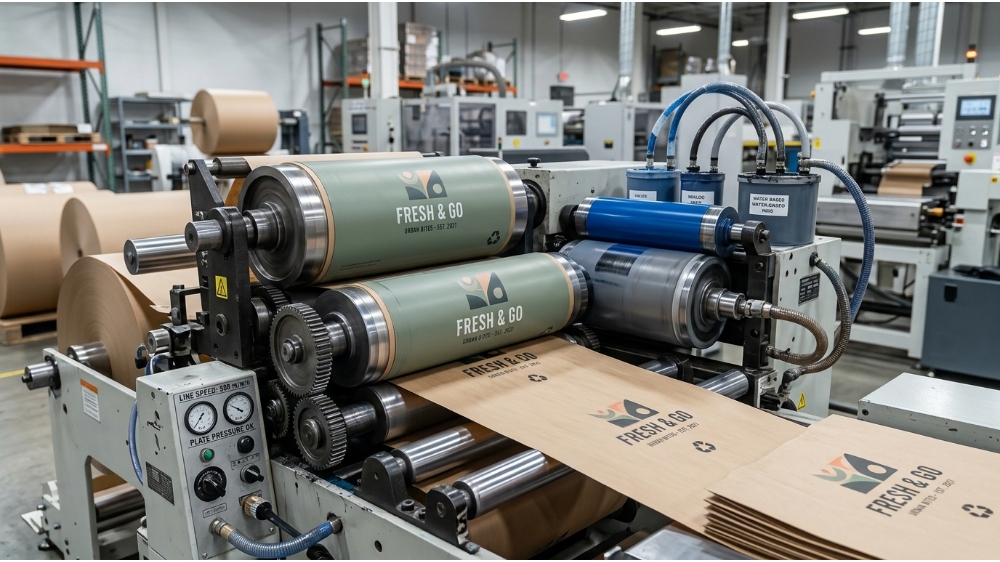
Flexography—commonly shortened to flexo—is the dominant printing technology for paper bags and flexible packaging. It uses rubber or photopolymer plates wrapped around rotating cylinders. Ink is transferred from an anilox roller to the plate and then directly onto the substrate. The process runs at high speed, making it exceptionally cost‑effective for large volumes.
Flexo excels at solid colours, line art, and simple spot‑colour logos—the typical restaurant or retail bag. It supports a broad range of ink types, including water‑based, solvent‑based, and UV‑curable formulations, many of which can meet food‑contact regulations. A study by Bolanča, Majnarić, and Golubović (2015) confirms that flexography offers an optimal balance of speed and quality for flexible packaging, making it the default for high‑volume runs.
However, flexo plate production and setup time mean that economies of scale only kick in above 5,000‑10,000 units. Below that, the per‑unit price is inflated by tooling amortisation. Lead times are typically 1‑3 weeks, depending on plate‑making and proofing cycles. For high‑volume foodservice or retail chains, flexo remains the undisputed workhorse.
Offset Printing for High‑Quality Designs
Offset lithography is a planographic process where the image is transferred from a plate to a rubber blanket, then to the paper. It delivers superior colour fidelity, sharpness, and consistency—often achieving 300+ lines per inch—making it the preferred choice for premium packaging that demands photo‑realistic imagery and Pantone‑matched spot colours.
Offset printing excels with complex gradients, fine typography, and large‑area coverage. It can print on coated papers that would be challenging for flexo due to ink transfer issues. The Flexo Revolution research (2012) notes that while offset historically led in quality, modern flexo has narrowed the gap; offset still wins for ultimate precision and colour control.
The trade‑off is cost and time. Offset plates are expensive, and make‑ready is lengthy, so the break‑even point is around 1,000‑2,000 units, with significant savings above 10,000. Turnaround is 2‑4 weeks, including proofing and plate production. For luxury retail, fashion, or high‑end food packaging, offset is often worth the investment.
Digital Printing for Small‑Batch Custom Paper Bags
Digital printing—whether toner‑based (HP Indigo) or high‑speed inkjet—eliminates plates altogether. A digital file goes straight to press, enabling rapid turnaround and low minimum orders. This makes it ideal for test runs, seasonal promotions, personalised bags with variable codes, or limited‑edition collaborations.
Quality is outstanding, with resolution often exceeding 1200 dpi and colour consistency that rivals offset. Since no plates are involved, setup is minimal, and each print can be different—perfect for QR codes or sequential numbering. However, the cost per bag remains relatively flat; at very high volumes, digital becomes more expensive than flexo or offset because ink/toner and substrate costs don’t decline as steeply. The sweet spot is typically 50‑2,000 bags.
Digital also enables rapid prototyping—you can order 100 bags, test them, and revise your artwork within days. The only downsides are slightly lower ink adhesion on uncoated kraft (though primers solve that) and a narrower colour gamut for some toner systems. For agility and low‑volume needs, digital is unbeatable.
Screen Printing for Simple Logos and Premium Effects
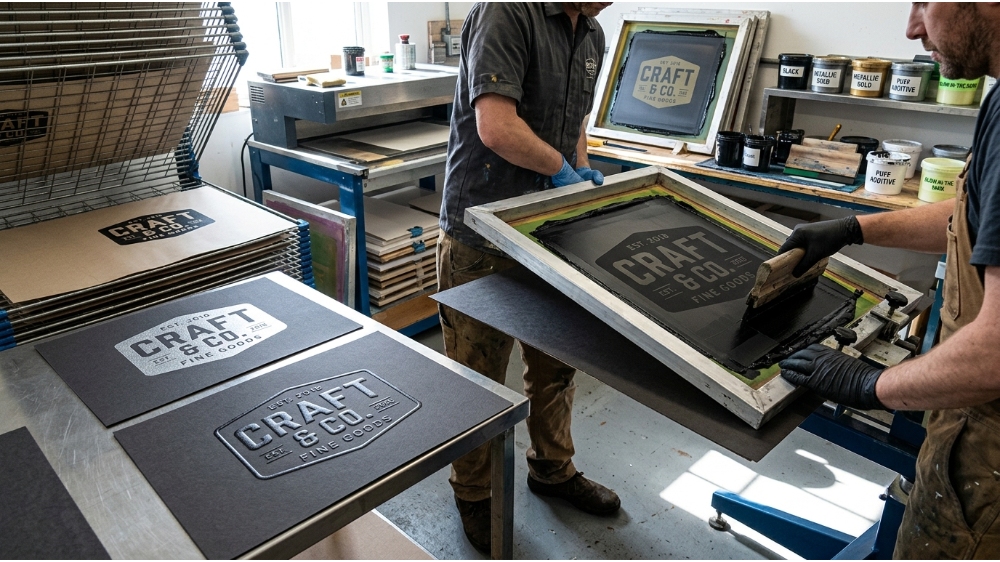
Screen printing forces ink through a fine mesh stencil onto the substrate, creating a thick, opaque film. It excels at bold, high‑impact graphics—large logos, blocky text, or designs that require a raised, textured feel. The ink layer is heavy and durable, making it resistant to rubbing and scuffing.
Screen printing allows for specialty inks such as metallic, glow‑in‑the‑dark, and puff (expanded) inks that create a 3D effect. It’s also used for printing on dark or uncoated papers where digital or offset may struggle with opacity. Setup costs are moderate, and it can be done on flat panels before folding. Minimum orders are typically 500‑1,000, and cost per unit is competitive for medium runs.
However, screen printing is limited to relatively simple designs—it’s not suitable for fine gradients or photographic detail. It shines when you want a tactile, premium feel that stands out from standard printed bags. Brands in craft beer, artisanal food, and luxury gifts often use screen printing to create a distinctive hand‑crafted appearance.
Special Finishes: Foil Stamping, Embossing & More
Beyond the primary printing methods, a range of specialty finishes can elevate your paper bag from ordinary to unforgettable. Foil stamping applies a metallic or pigmented foil using heat and pressure, creating a shiny, reflective accent—ideal for logos, monograms, or key brand elements. Embossing raises the paper surface to create a three‑dimensional relief, while debossing presses it inward for a subtle indentation.
Other finishing options include spot UV coating (glossy highlights on specific areas), soft‑touch laminate for a velvety feel, and perforation or scoring for functional tear‑open features. These are typically applied after printing, often in a separate pass, and can be combined with any of the five print methods to achieve a unique brand expression.
While these finishes add cost and extend lead time (often by 1‑2 weeks), they significantly enhance perceived value and unboxing experience. They are best used for premium product lines, gift packaging, or brand‑launch events where differentiation is critical. Always test the combination of finish and substrate to ensure adhesion and durability.
How to choose the right printing method
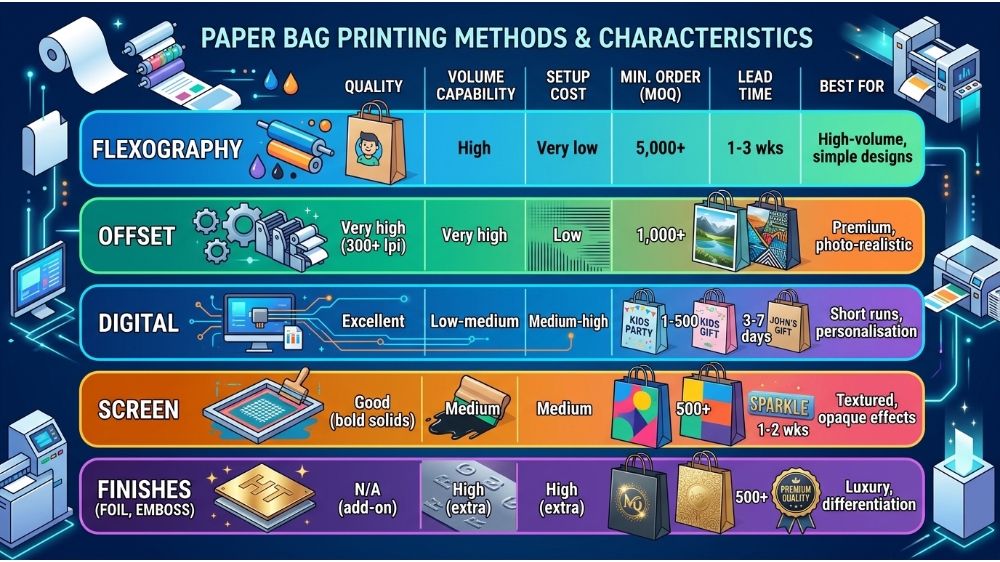
Decision‑making starts with three numbers: your annual volume, your design complexity, and your budget per bag. Use the comparison table below to short‑list methods that fit your volume bracket, then evaluate based on colour requirements and desired tactile effect.
Method
Print quality
Cost per unit (low vol)
Cost per unit (high vol)
Min. order
Turnaround
Best for
Flexography
Good (up to 150 lpi)
High
Very low
5,000+
1‑3 wks
High‑volume, simple designs
Offset
Very high (300+ lpi)
Very high
Low
1,000+
2‑4 wks
Premium, photo‑realistic
Digital
Excellent
Low‑medium
Medium‑high
1‑500
3‑7 days
Short runs, personalisation
Screen
Good (bold solids)
Medium
Medium
500+
1‑2 wks
Textured, opaque effects
Finishes (foil, emboss)
N/A (add‑on)
High (extra)
High (extra)
500+
+1‑2 wks
Luxury, differentiation
For example, a QSR ordering 200,000 bags per year should default to flexo—it will deliver the lowest total cost, especially with water‑based inks that are food‑safe. A boutique coffee roaster needing 1,000 bags with a four‑colour illustration might choose digital for speed or offset if they have longer planning and want premium print. If you’re unsure, order sample runs from a converter who offers multiple technologies. Learn more about paper bag costs by reading Bulk Paper Bag Cost Guide – Wholesale Pricing Factors.
Decision checklist:
What is your estimated monthly / yearly bag usage?
How many colours and what coverage does your design require?
Is the bag for direct food contact? (requires low‑migration inks)
Do you need variable data or personalisation?
What is your acceptable lead time?
Also consider sustainability: water‑based inks and uncoated paper are more recyclable than solvent‑based or laminated alternatives. Discuss your environmental goals with your packaging supplier.
Frequently Asked Questions
Which printing method is cheapest for paper bags?
For high volumes (over 10,000), flexography is the cheapest per unit because plate costs are amortised. For low volumes (under 500), digital printing has no plate fees and is more economical.
Can I print full‑colour photographs on paper bags?
Yes—offset and high‑end digital presses reproduce full‑colour images with excellent detail. Flexo can handle process colour but is limited to simpler designs due to screen ruling constraints.
What is the minimum order for custom printed paper bags?
Digital printing allows orders as low as 1‑50 bags, while flexo and offset typically require 1,000‑5,000 to be cost‑effective. Screen and specialty finishes fall in between, usually 500‑1,000.
Do printed paper bags need a food‑grade certification?
If the bag directly contacts food, yes—you need low‑migration inks and a barrier coating. Your printer should provide documentation confirming compliance with FDA or EU food‑contact standards.
Ready to order custom‑printed paper bags for your brand?
Talk to a packaging specialist about your volume, design, and delivery needs. We’ll help you select the right printing method and material combination.