

Pizza Box Sizes Chart: Standard Dimensions Guide
Pizza Packaging Guide
Pizza Box Sizes Explained: Standard Dimensions and How to Choose the Right Size
From an 8-inch personal box to a 24-inch party jumbo — how pizza diameter, clearance, flute type, and freezer-shelf space all decide the “right” size.
A standard pizza box runs from an 8″ x 8″ personal box up to a 24″ x 24″ party jumbo, with 12″, 14″ and 16″ boxes covering most everyday delivery and takeout orders. The right pick depends less on the pizza’s advertised diameter and more on clearance, box height, flute strength, and where the box has to physically travel — on a delivery bike, in a stack of ten, or on a supermarket freezer shelf.
This guide lines up every standard size in inches and centimeters, then goes further than a typical size chart by explaining why the biggest U.S. chains standardize on different box numbers than their pizza’s diameter, and why frozen retail brands often abandon the round box altogether. For a full range of ready-to-order pizza packaging, see this packaging solution overview.
What Is a “Standard” Pizza Box Size?
A pizza box’s labeled size almost always refers to the outer dimension of the box in inches — 12″, 14″, 16″ — not the actual diameter of the pizza it holds. That gap exists on purpose: a box needs enough clearance around the crust so the pie doesn’t touch the walls, plus enough interior height for cheese pull, toppings, and steam to escape without soaking the lid.
The word “pizza box size” also means different things depending on who’s asking. A pizzeria owner is usually asking which box fits a specific dough diameter. A packaging buyer is asking for length x width x height in inches or millimeters for print and die-cut specs. And a home cook searching “12 inch pizza box” is often just trying to confirm whether their delivery pizza will fit in the fridge. None of these three questions have the same answer, which is why size charts that only list one number — “12-inch box” — leave out the information that actually matters for ordering.
Demand for pizza packaging tracks a genuinely large market. The U.S. pizza restaurant industry is on pace to reach roughly $50.4 billion in revenue in 2026, spread across more than 75,000 businesses, according to IBISWorld’s industry analysis. That volume is also shifting: Pizza Today’s 2026 Industry Trends Report found roughly 84% of operators now report online-ordering sales, a channel that leans harder on stackable, delivery-ready box sizes than dine-in service ever did — one reason box strength and stacking height matter as much as the ounce-style size label.
Pizza Box Size Chart: Inches, cm, and Pizza Diameter Compared
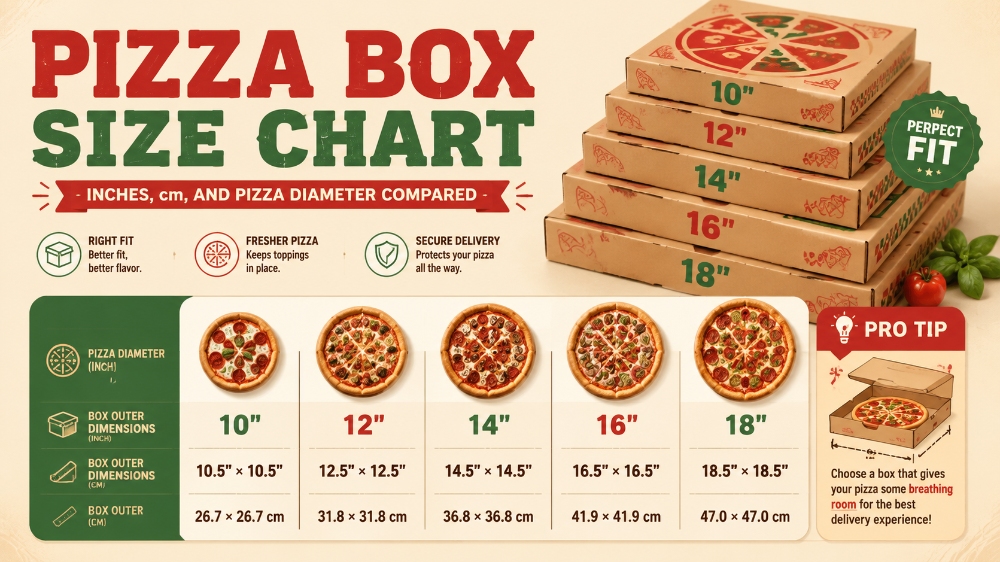
Box outer dimension and pizza diameter are two different specifications, and mixing them up is the most common reason a “12-inch” box order arrives too tight for a fully topped 12-inch pie. The chart below lines up pizza diameter, typical outer box dimensions, and metric conversions so the numbers you compare match real packaging.
| Size | Pizza diameter | Typical box (outer) | Metric | Best suited for |
|---|---|---|---|---|
| Personal / Mini | 6–8″ | 8″ x 8″ x 2″ (some 9″ x 9″) | ~20 x 20 cm | Personal pan pizzas, kids’ menu, single slices |
| Small | 9–10″ | 10″ x 10″ x 2″ or 12″ x 12″ x 2″ | ~25–30 cm | Solo orders, small appetite couples |
| Medium | 12″ | 12″ x 12″ x 2″ or 14″ x 14″ x 2″ | ~30–35 cm | The most-ordered everyday takeout and delivery size |
| Large | 14″ | 16″ x 16″ x 2″ | ~40 cm | Family orders, 3–5 people, most chain “large” boxes |
| Extra Large | 16″ | 18″ x 18″ x 2″ | ~45 cm | Loaded/specialty pizzas, group delivery |
| Jumbo / Party | 18–20″+ | 20″ x 20″ x 2″ up to 24″ x 24″ x 2″ | ~50–60 cm | Catering, parties, events, feeding a crowd |
These box brackets aren’t arbitrary. Foodservice suppliers converge on the same handful of outer dimensions — roughly 7″–10″ for personal and small boxes, 12″–16″ for medium and large, and 18″–24″ for extra-large and party sizes, per WebstaurantStore’s pizza box sizing guide — so that suppliers can mass-produce square corrugated blanks efficiently and pizzerias can stack mismatched orders on the same delivery rack. Independent sizing research from Boxzilla’s dimension guide places large boxes at 18″ x 18″ x 2″ and family-shaped boxes at 20″ x 20″ x 2″, confirming the same step pattern shows up across manufacturers even when the exact inch labels shift by a size class.
Why the Box Number Is Never the Pizza Number
A box labeled 14″ x 14″ does not give a 14-inch pizza 14 inches of clearance — corrugated wall thickness and fold allowance eat into that number immediately, and the same box is measured differently by different manufacturers depending on whether they publish outer or inner dimensions. Confirming which one you’re looking at before ordering avoids the single most common pizza-packaging mistake.
Manufacturers typically publish outside box dimensions, but usable interior space runs smaller. Per The Environmental Blog’s pizza box dimensions guide, a 14″ x 14″ box provides roughly 13.5″ x 13.5″ of actual interior space, with an additional 0.5 to 1 inch of clearance generally recommended around the pizza’s baked diameter — not its raw dough diameter — to protect the crust in transit. Restaurants that size boxes off dough diameter instead of the fully baked pie routinely end up ordering one size too small, since dough rises and spreads meaningfully in the oven.
Box height is the other number that gets overlooked. The 2-inch depth that covers a standard hand-tossed or thin-crust pizza isn’t enough for deep-dish, stuffed-crust, or heavily topped pies, which typically need 3 to 3.5 inches of interior height to keep the lid from pressing into the cheese and sliding toppings off during delivery.
Before finalizing a pizza box order, confirm:
- Whether the published dimension is outer (box) or inner (usable) space
- Clearance against the fully baked pizza diameter, not the raw dough size
- Box height against your tallest crust style — 2″ standard vs. 3″+ for deep-dish
- Whether your printer’s die-cut template matches the supplier’s actual fold lines
What Pizza Box Sizes Do Major Chains Actually Use?
Large chains rarely size their box to match the pizza’s diameter one-to-one — they size it to a small, fixed set of box dimensions that every kitchen in the system can stock, fold, and stack the same way, no matter what pie goes inside. That standardization matters more as chain volume grows: PMQ’s 2026 Pizza Power Report puts Domino’s 2024 U.S. sales at $9.5 billion across more than 7,000 units, with Pizza Hut, Little Caesars, and Papa Johns each running thousands of locations behind them — a scale where even a half-inch of box inconsistency compounds into real cost and jam-prone assembly lines.
| Chain | Typical pizza sizes | Common box dimension | |
|---|---|---|---|
| Domino’s | Small 10″, Medium 12″, Large 14″, XL 16″ | 16″ x 16″ for large pizzas | |
| Pizza Hut | Personal, Medium 12″, Large 14″ | 12″ x 12″ and 14″ x 14″ most common | |
| Little Caesars | Classic 14″ | 14″ x 14″ | |
| Papa John’s | Medium 12″, Large 14″, XL 16″ | 16.75″ x 16.75″ |
Chain sizing conventions come from Silveredge Packaging’s comparison of box dimensions across Domino’s, Little Caesars, Papa John’s, and Pizza Hut, and Domino’s own U.S. size ladder — 10″, 12″, 14″ and 16″ pizzas — is documented across multiple Domino’s size breakdowns confirming the medium at 12 inches and the large at 14 inches in diameter. Note the gap between Domino’s 14″ large pizza and its 16″ x 16″ box: that’s clearance and lid pull-tab space, not measurement error, and it’s the same principle covered in the section above.
The practical lesson for independent pizzerias: matching a chain’s exact box number isn’t the goal — matching a chain’s fixed, small size ladder is. Two or three well-chosen box sizes that share fold tooling and stacking height will move faster through a kitchen than five box sizes chosen to match every dough diameter on the menu.
B-Flute vs. E-Flute: How Material Affects Size Choice
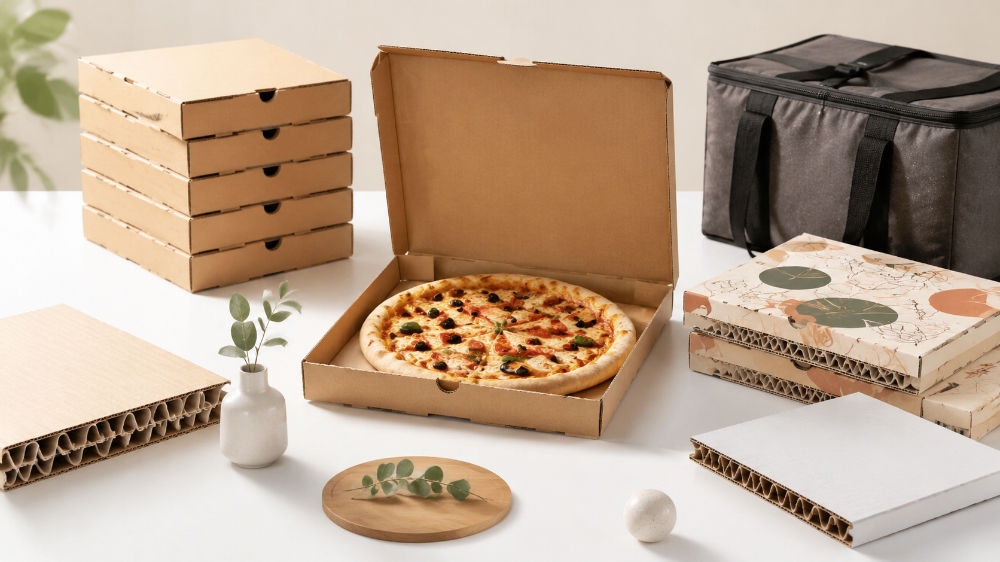
The flute — the wave-shaped inner layer of corrugated board — decides how much of a given box dimension survives a delivery run intact, and it should be chosen alongside size, not after it. Two boxes cut to the exact same 16″ x 16″ footprint can behave completely differently depending on which flute sits between the liners.
B-flute, at roughly 1/8 inch thick, is the delivery workhorse: its extra rigidity gives larger boxes the compression strength to stack ten-high in a hot bag without collapsing. E-flute, at about half that thickness, trades some of that stacking strength for a smoother printable surface and tighter flute spacing that W Packaging’s flute comparison credits with better insulation and moisture control, helping reduce sogginess on shorter routes.
Size and flute choice interact directly: a 20″–24″ jumbo box under heavy toppings needs B-flute’s rigidity to avoid sagging in the middle, while a 10″–12″ personal or retail box, where branding and shelf presentation matter more than stacking depth, is a better fit for E-flute’s cleaner print surface. Suppliers selling both note that flute selection should be matched to pizza size, delivery distance, and branding needs together, not treated as an afterthought to the size order.
Frozen Pizza Retail Sizing and Freezer Case Dimensions
A frozen pizza box has to fit twice: once on a delivery pallet, and once inside a supermarket freezer case engineered around a fixed door width and shelf depth. Get the second fit wrong, and a perfectly good product never earns consistent facing on the planogram.
Retail frozen pizzas follow a looser but recognizable size ladder: personal-sized frozen pizzas typically run 6–8 inches, medium sizes 10–12 inches, and family-sized pizzas 14–16 inches or larger, according to Foods Guy’s brand-by-brand breakdown. Where frozen retail diverges sharply from foodservice is shape: most national frozen pizza brands ship in a rectangular box rather than a round or square one, commonly around a 12″ x 16.5″ footprint, because a rectangle nests more densely on a wire freezer shelf than a square box sized to a round pie.
Shelf and case dimensions set a hard ceiling on that footprint. Commercial single-door reach-in freezers used by many independent stores and food-service commissaries typically run 27 to 31 inches wide and 35 to 82.5 inches tall, per The Restaurant Warehouse’s commercial freezer sizing guide, while large-format supermarket freezer aisles are typically fitted with adjustable wire shelving and merchandising rails built around a common 20-inch shelf depth — the same depth that dedicated frozen-pizza shelf systems like Henschel’s EZ Load 20-inch shelf kit are engineered to fit.
That 20-inch depth is the constraint most packaging buyers miss. It doesn’t just cap how many rows of boxes fit front to back — it also determines how much of a tall, narrow box’s front panel stays visible once a second row sits behind it. A shorter, wider rectangular box frequently outsells a taller square one in the same freezer footprint purely because more of its branding stays in a shopper’s line of sight, the same shelf-visibility logic that governs any packaged product competing for a 20-inch-deep slot.
Before finalizing a retail frozen pizza box, check:
- Finished pack height and width against the 20-inch shelf-depth standard
- Whether a rectangular footprint improves shelf density versus a square box
- Freezer door width class — countertop, single-door reach-in, or full glass-door case
- How much front-panel branding stays visible once a second row sits behind it
How to Choose the Right Pizza Box Size for Your Situation
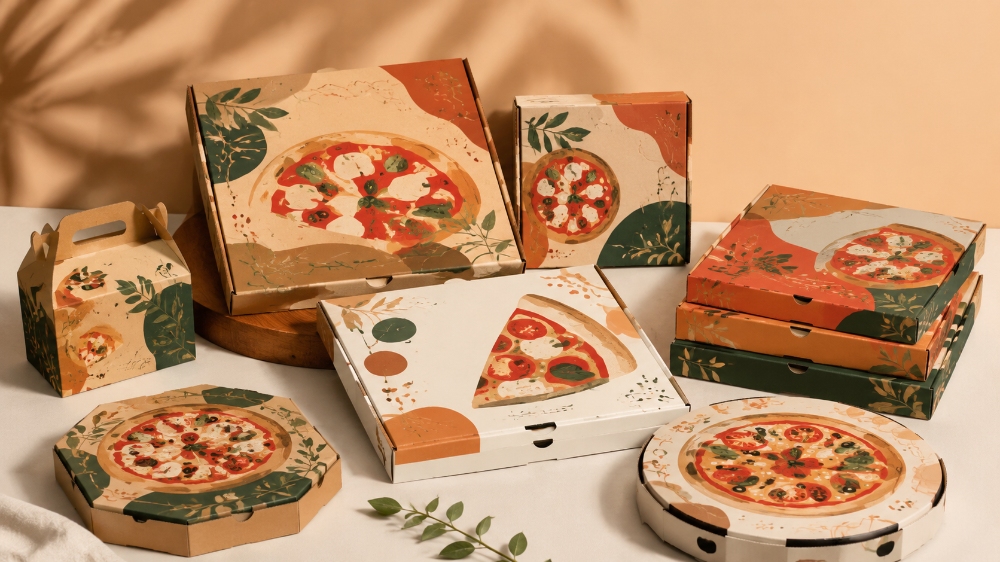
The “right” standard size changes depending on who’s buying — an independent pizzeria optimizing delivery costs, a QSR chain standardizing across thousands of units, a home host planning a party order, a caterer serving a crowd, or a retail buyer working around a planogram. Matching the buyer’s situation to a size, rather than defaulting to whatever number sounds biggest, avoids both crushed pizzas and wasted packaging spend.
| Who’s choosing | Recommended size | Why |
|---|---|---|
| Independent pizzeria owner | 12″ and 16″ core, 8″ for personal/kids | Two or three sizes keep fold tooling and stacking simple without limiting menu range |
| Drive-thru / QSR chain | 14″–16″ box on a fixed ladder | Matches chain-scale standardization; fewer SKUs, faster line assembly |
| Home host / party planner | 18″–20″ jumbo or multiple 12″ boxes | One jumbo reduces box count; multiple mediums allow topping variety |
| Event or catering planner | 16″–20″ in bulk, B-flute construction | Handles stacking and hot-bag transport for large orders without collapsing |
| Retail / frozen brand buyer | Rectangular box sized to 20″ shelf depth | Maximizes shelf density and front-facing brand visibility in freezer cases |
Businesses evaluating a full lineup rather than a single size can review ready-made options such as custom-printed corrugated pizza boxes or fully bespoke packaging by pizza diameter and flute type before committing to a production run. Whatever the segment, the same rule applies: test the actual pizza, box, and stacking method together before finalizing a size — the inch number on a spec sheet is only the starting point. Click to get connected with your packaging expert, Maibao Packaging.
Not sure which size fits your menu?
Talk to a packaging specialist about matching pizza box size, flute strength, and freezer-shelf dimensions to your actual product line.
Frequently Asked Questions
What is the standard pizza box size for a 12-inch pizza?
Most 12-inch pizzas ship in a 12″ x 12″ x 2″ or 14″ x 14″ x 2″ box, depending on whether the supplier builds in extra clearance. Confirm interior versus outer dimensions before ordering, since the two numbers can differ by half an inch or more.
Why is my pizza box bigger than my pizza?
Boxes are sized with 0.5 to 1 inch of clearance around the fully baked pizza diameter to protect the crust and toppings in transit. Corrugated wall thickness also eats into the labeled dimension, so the usable interior space is always slightly smaller than the outer box size.
What size box does a large pizza need?
A 14-inch large pizza typically needs a 16″ x 16″ x 2″ box, which is the size most major chains use for their large tier. Deep-dish or stuffed-crust large pizzas usually need a taller 3-inch depth rather than the standard 2-inch height.
Should I use B-flute or E-flute for my pizza boxes?
B-flute is the better choice for larger boxes and longer delivery routes because its thicker structure resists collapsing when stacked. E-flute suits smaller retail or dine-in boxes where a smoother, more printable surface and better insulation matter more than heavy-duty stacking strength.
Post time: Jul-17-2026