

This comparison is built for B2B buyers sourcing food buckets for fried chicken, loaded fries, popcorn chicken, and similar menus. It separates the oil-resistance mechanism from the coating label, the print expectation from the achievable graphic, and the quoted unit price from the failure-adjusted cost.
Paperboard vs. Molded-Fiber Food Buckets: Oil, Print, Structure, Cost
Foodservice Packaging Sourcing
Paperboard vs. Molded-Fiber Food Buckets: Differences in Oil Resistance, Print Quality, Structure, and Cost
Paperboard and molded-fiber buckets resist oil differently: paperboard relies on a barrier coating, molded fiber on wall density. That difference drives print fidelity, stacking, tooling economics, and true cost per unit. This guide compares both formats on the four variables that decide most B2B sourcing choices.
A fried chicken bucket or a loaded fries bucket is a high-grease, high-heat, high-humidity package. The material must manage surface oil, escaping steam, and mechanical load at the same time. Paperboard and molded fiber handle those three stresses from different starting points, and the procurement decision is rarely a simple “sustainable vs. traditional” choice.
Oil Resistance: Coating Barrier vs. Structural Density
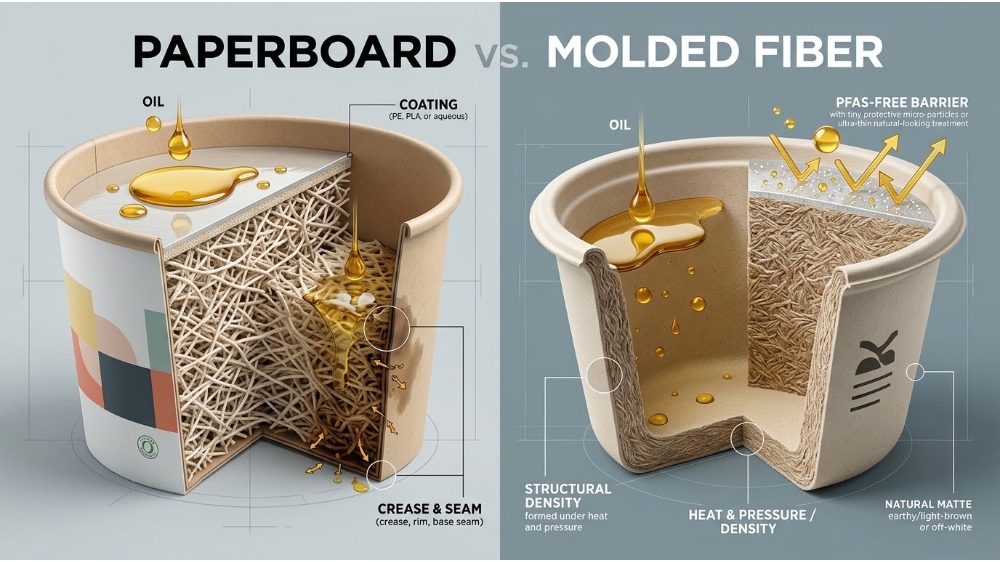
Paperboard resists oil through an applied barrier, while molded fiber relies on the density of its formed wall. That difference determines how each behaves at the bucket’s creases, rim, and base seam, where grease failure usually begins.
Uncoated paperboard wicks oil into the fiber network, softening the board and producing visible stains. Paperboard buckets therefore need a coating—PE, PLA, or an aqueous dispersion—on the food-contact surface to interrupt the oil path.
Molded fiber is formed under heat and pressure into a dense three-dimensional wall, giving it a baseline of grease resistance without a plastic film. It handles moderately greasy menus and short holds, but not very oily foods or long holds. PFAS-free barrier technology improves performance. A cellulose nanofibril coating at 5 g/m² has reached a Kit value of 9–11 and reduced oil absorption by roughly 92% versus uncoated samples.
PFAS restrictions add a compliance variable: PE resists grease well but is not compostable, PLA is industrially compostable but has a lower heat-distortion threshold, and aqueous coatings sit between the two. Paperboard always needs a coating; molded fiber provides a structural baseline but still requires a PFAS-free barrier for high-grease buckets. Neither material is truly coating-free across all fried menus.
Print Quality: Flat Stock vs. Formed Fiber
Paperboard is printed flat before forming; molded fiber is formed first and printed secondarily. That order explains most print-quality differences.
A paperboard bucket starts as a flat sheet, so graphics go on by offset or flexo before cutting, rolling, and seaming. Offset holds fine type, gradients, and registration; flexo handles solid colors at volume. Flat printing makes results predictable.
Molded fiber has no flat stage: the body is formed in a 3D mold with a rough, porous, curved surface. Uneven fiber breaks fine lines, absorbency causes wicking, offset cannot run on the formed part, and batches shift in tone. Screen, pad, flexo, and digital can apply bold logos, but not offset-grade detail.
For a brand-billboard bucket, paperboard holds a structural print advantage. Molded fiber can carry a credible logo and solid color, but not fine serif type, soft gradients, or exact Pantone matches. If the bucket is a brand asset, this gap matters.
Structure: Rolled-Rim Paperboard vs. Thick-Wall Molded Fiber
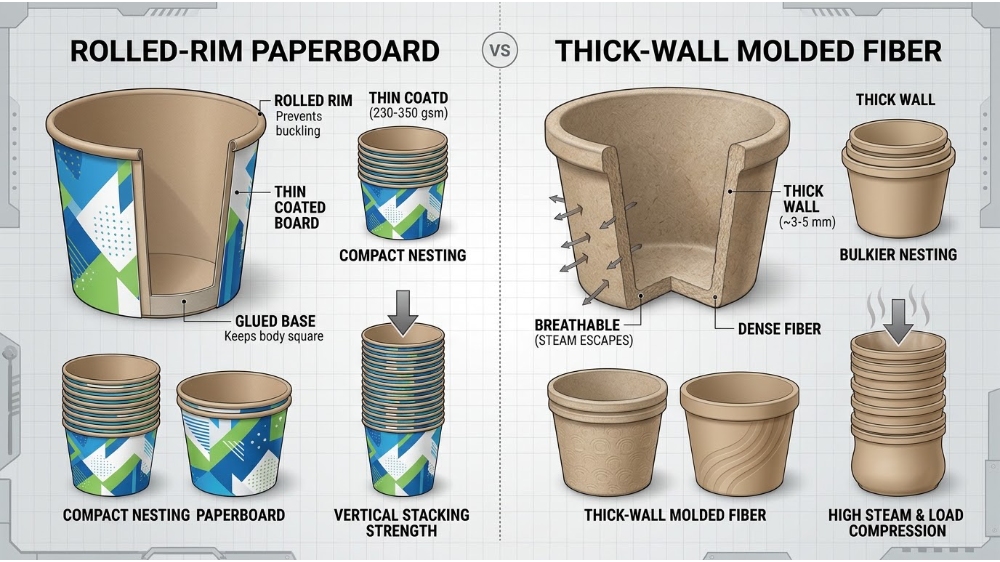
Paperboard buckets get rigidity from geometry—a rolled top rim and glued base—while molded fiber gets it from wall mass and density. Both work, but they fail differently.
A paperboard bucket uses a coated board body, separate base, and rolled top edge. The rim resists buckling when lifted, and the glued base keeps the body square and the seam closed, so the wall can be thin.
Molded fiber uses a thick wall, often several millimeters, with rigidity from the formed shell’s mass and density. It holds shape under heat and stacking, and breathes modestly so some steam escapes—good for fried and greasy solids. The trade-off is storage and stacking: paperboard nests compactly, while molded fiber is bulkier and can compress under high steam stacks, though paperboard holds vertical stacking strength better when board weight and coating match the load.
| Structural variable | Paperboard bucket | Molded-fiber bucket |
|---|---|---|
| Primary rigidity source | Rolled rim + glued base + board stiffness | Wall thickness and fiber density |
| Typical wall thickness | Relatively thin board, often 230–350 gsm + coating | Several millimeters, formed under heat and pressure |
| Stacking strength | Good when board weight and rim are specified for load | Good under load, but steam and high stacks can compress walls |
| Storage footprint | Compact when nested or stacked before use | Bulkier per unit; more warehouse space required |
| Steam behavior | Depends on venting; sealed coating traps moisture | Breathable wall allows modest vapor escape |
Cost: Unit Price, Tooling, and Failure-Adjusted Economics
Paperboard buckets usually win on quoted unit price; molded fiber competes on failure-adjusted cost. Unit-price comparisons favor paperboard and miss post-delivery costs.
PE-coated paperboard buckets sit in the low single-digit to low-teens cent range, while molded-fiber containers run roughly $0.12–$0.25 per unit at mid-volume—paperboard can be about half the unit cost. Tooling also differs: paperboard dies are relatively cheap, while molded-fiber molds commonly cost $1,500–$8,000 per SKU with longer lead times, making them uneconomical for small or frequently changing menus.
The decisive number is failure rate. A paperboard bucket with compromised coating or unvented design can wick grease and soften, and refunds or remakes can exceed per-unit savings. Molded fiber’s higher price buys tolerance on wet, hot, greasy loads. Paperboard has the lower price and tooling barrier, but molded fiber can lower true cost per successful delivery.
How to Match the Bucket to the Menu and the Last Mile
The right format is the one whose failure mode your menu can tolerate least. Start with grease load and hold time, not the sustainability label or unit price.
For a high-grease fried-chicken bucket with a 15-minute-plus delivery window, ask whether the oil barrier survives the rim, base seam, and creases. Coated paperboard works if coating weight and coverage match the grease load and the bucket vents steam away from the food. Molded fiber works if wall density and any PFAS-free barrier are validated against the actual oil load and stacking does not compress the walls under steam.
For a brand-heavy bucket, print capability should push the decision toward paperboard unless sustainability positioning is the dominant brand message. Molded fiber can carry a simplified logo and an eco-premium signal, but not the graphic detail of a lithographed paperboard bucket.
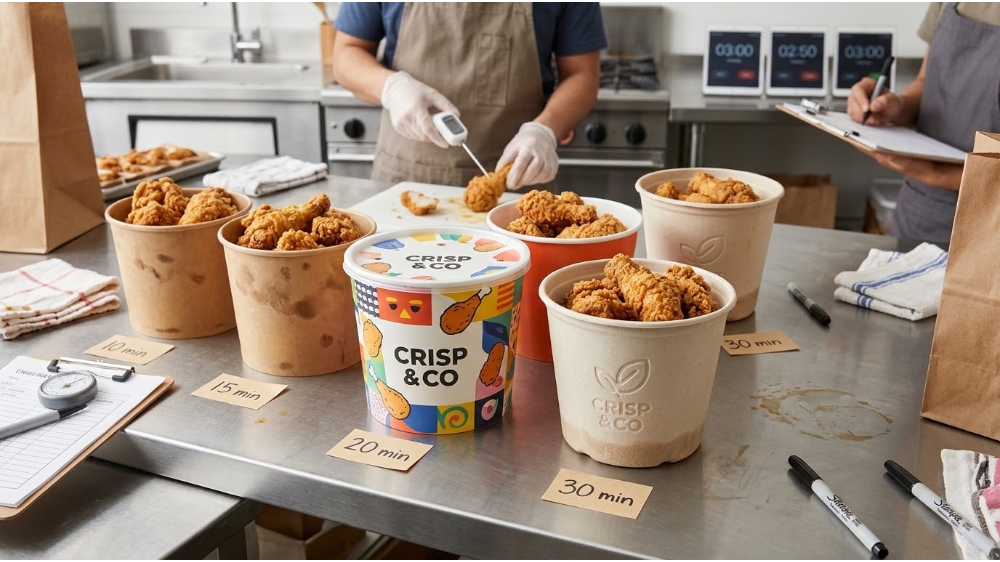
Run a hold test before committing: pack the actual menu item at fill temperature, close the bucket as the store would, and check the bucket and food at 10, 15, 20, and 30 minutes. Record grease staining, board or wall softness, and food texture. The format that fails first in your operating window is the one to exclude, regardless of unit price or marketing story.
Need food bucket packaging matched to your grease load and delivery window?
Talk to a packaging specialist about paperboard or molded-fiber bucket formats, barrier options, and print methods for your specific fried menu.
Frequently Asked Questions
Is molded fiber always more oil-resistant than paperboard?
No. Uncoated molded fiber has a density advantage over uncoated paperboard, but high-grease foods can still penetrate molded fiber without an added barrier. Coated paperboard can match or exceed the grease resistance of uncoated molded fiber. The comparison only becomes meaningful when the coating system and the actual oil load are specified for both formats.
Can molded-fiber buckets achieve the same print quality as paperboard?
Not for offset-grade graphics. Molded fiber’s rough, porous, three-dimensional surface prevents conventional offset printing on the bare part and limits fine type, gradients, and exact Pantone matching. Bold logos and solid colors are achievable through screen, pad, flexo, or direct-to-shape digital methods. Paperboard is printed flat before forming, which is why it holds graphic detail more predictably.
Why is molded-fiber tooling more expensive than paperboard tooling?
A paperboard bucket is formed from a flat sheet using cutting dies and seam tooling, which are relatively inexpensive and fast to change. A molded-fiber bucket requires a shaped three-dimensional mold, and custom molds commonly cost from about $1,500 to $8,000 per SKU. That tooling investment only makes sense when the order volume and the format’s performance advantages justify it.
Does the PFAS restriction affect both material types equally?
The restriction applies to food-contact packaging regardless of substrate, so both coated paperboard and treated molded fiber must comply. The practical difference is that paperboard has historically relied on PFAS for grease resistance, while molded fiber can achieve a baseline of grease resistance through density alone. Both formats can now use PFAS-free barrier systems, but the performance and cost of those systems vary by coating chemistry and application.
Post time: Nov-02-2026