Mini, Regular & Stacked Burgers: Standard Guide for Box Height & Structure Selection
Mini, Regular & Stacked Burgers: Box Height Guide
Foodservice Packaging Guide
Mini, Regular & Stacked Burgers: Standard Guide for Box Height & Structure Selection
Pick by burger, not labels: mini=compact, regular=headroom, stacked = taller + side support. Measure the assembled burger, check internal size, and test closed-box handling/delivery. Size ranges are just starting points; the box must protect without squeezing or shifting.
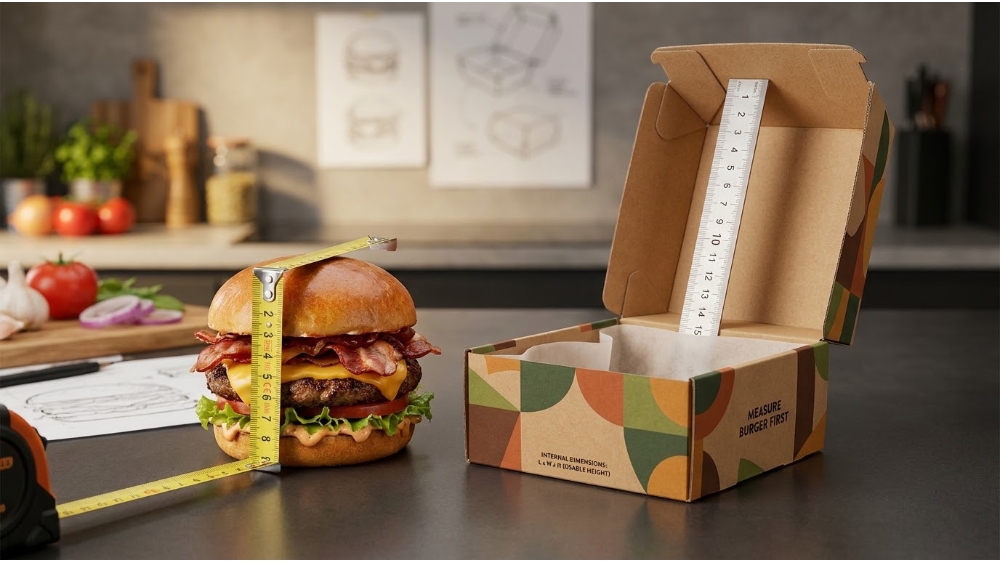
The most reliable way to select burger box height is to measure the finished burger from the bottom bun to the highest point of the top bun, then allow enough internal clearance to close the box without compressing the food. The required space varies with bun shape, toppings, sauces, and how consistently the kitchen assembles each burger.
For purchasing decisions, separate three measurements: the burger’s assembled height, the box’s usable internal height, and its external height. These are not interchangeable. The following guide explains how to use them when sourcing packaging for mini, regular, and stacked burgers, with practical starting ranges and a sample-approval process for foodservice buyers.
Start with the Burger, Not the Box Label
A box described as mini, regular, or large does not guarantee a suitable fit. These labels vary between suppliers, and two burgers in the same menu category can have different heights because of bun shape, patty thickness, cheese, vegetables, and sauces. Buyers should specify the dimensions of the actual assembled product before confirming a box size.
Start with three measurements:
Length and width: Measure the burger at its widest points after assembly. A round bun may not stay perfectly circular once toppings and patties are added.
Finished height: Measure from the bottom of the lower bun to the highest point of the top bun without pressing the burger down.
Usable internal box height: Confirm the available space when the box is assembled and closed, accounting for the lid shape, folded panels, and closure features.
Internal dimensions determine whether the food fits. External dimensions matter for storage, master-carton planning, and delivery-bag capacity. If a supplier quotes only length, width, and height without stating whether the figures are internal or external, confirm the measurement convention before comparing options.
Buyer rule: Measure the burger in its normal serving configuration, including the toppings and any liner or wrap that will be packed with it. Do not size the box around the patty alone or a flattened measurement that compresses the bun.
The box must also fit the way the kitchen works. Staff should be able to load the burger without scraping toppings against the walls, then close the lid without forcing the tabs or hinge. If the burger is wrapped before boxing, the wrap can add bulk and change how easily the product sits inside the cavity.
Mini Burgers: Compact Height Without Squeezing
Mini burgers and sliders generally benefit from a compact box that keeps the food controlled during handling. The goal is not to make the cavity as small as possible. It is to reduce unnecessary movement while preserving enough space for the bun, fillings, and a reliable closure.
For an initial specification, a mini burger with an assembled height of roughly 1.5–2 inches may lead buyers to investigate a box with an internal height around 2–2.5 inches. Treat this as an illustrative planning range only. A soft brioche bun, a thick sauce layer, or a tall garnish may require a different configuration.
Mini burgers can be especially sensitive to excess space. If the base is much wider than the burger, the food may slide when the bag is moved. If the cavity is too shallow, the lid can press the top bun or move small toppings out of position. A compact fit should still allow staff to place and remove the burger without pinching it.
When several sliders are packed together, decide whether each burger needs its own cavity or whether a shared compartment is suitable. Separate spaces can limit contact between burgers, but the overall tray or box footprint must still suit the order quantity and the way it will be carried.
For buyers ordering multiple mini-burger formats, test the smallest and tallest regular builds in the proposed packaging. If one box is intended to cover several menu items, confirm that the compromise does not leave the smaller burger moving excessively or force the larger one against the lid.
Regular Burgers: Balancing Clearance and Stability
A regular single-patty burger needs enough internal height to protect the top bun and toppings while keeping the burger stable on the base. The right box should close naturally, without requiring staff to push down on the lid or rearrange ingredients to make the tabs meet.
For a conventional burger with an assembled height around 3–3.5 inches, an internal box height in the approximate 3.5–4-inch range can be a useful starting point for supplier discussions. This is not a fixed standard: a flatter smash burger may need more footprint than height, while a thick bun or a generous layer of toppings may need additional vertical space.
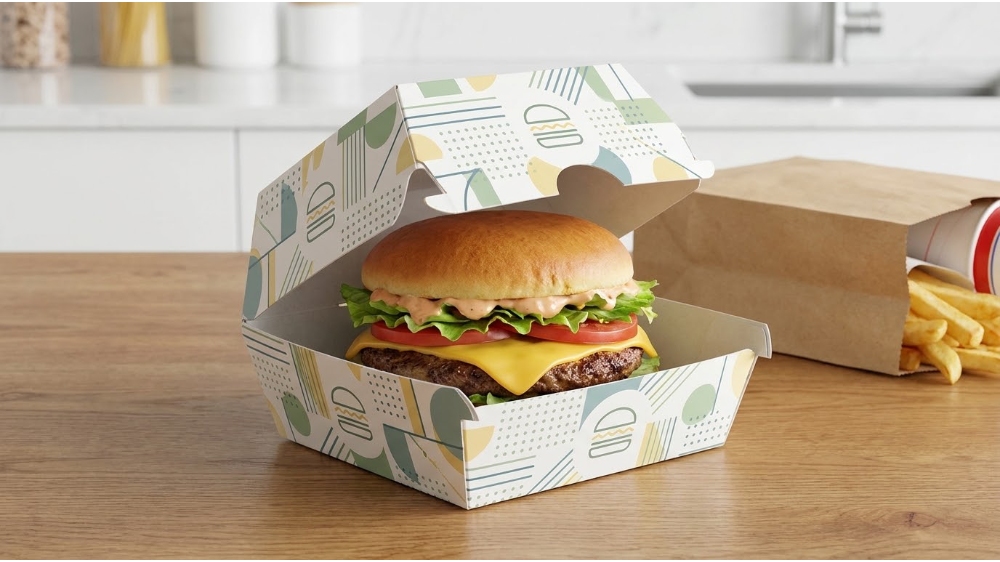
A conventional hinged or clamshell box can be a practical starting format because the base and lid are connected and the pack can be closed in one operation. However, the style alone does not guarantee a good fit. A shallow lid may touch the bun even when the base dimensions are correct, and a large cavity can allow the burger to tilt during transport.
Check the full closed shape, not just the height of the base walls. Some designs have a raised lid; others have a flatter top or folded closure panels that reduce usable space. Ask for internal dimensions with the box assembled, and verify them against a physical sample.
If the burger is part of a delivery order, consider how the closed box will sit in the bag with drinks and side items. The burger should remain upright under normal handling, and the lid should stay closed without placing pressure on the food. A box that works on a counter may behave differently once several orders are packed together.
Stacked Burgers: When a Taller Cavity Is Not Enough
Double- and triple-patty burgers often need more vertical clearance, but height alone does not solve every packaging problem. A tall stack may be top-heavy, and loose toppings or sauces can move when the box tilts. Buyers should consider the cavity, sidewalls, lid geometry, closure, and base support as one system.
For an assembled burger around 5–6 inches tall, a box with an internal height around 6–6.5 inches may be worth evaluating as an initial reference. Actual requirements depend on the build and the available box design. Do not add a fixed amount of height for every extra patty: patties may compress slightly under their own weight, while tall buns, lettuce, tomato slices, and other toppings can increase the finished height in less predictable ways.
A deeper cavity can help when a burger needs more room above the bun and a more substantial sidewall. However, a taller box with a narrow base may still be unstable. Conversely, a wider box may provide a more stable footprint but leave too much room around a smaller burger. The correct balance depends on the burger’s footprint and centre of gravity, not simply the number of layers.
Review these details when comparing structures:
Sidewall support: The walls should help contain the burger without pressing against its toppings.
Lid clearance: The highest point of the assembled burger should not touch the lid during normal closure.
Closure security: The tabs or locking features should stay engaged during bagging and routine movement.
Base stability: The base should support the loaded burger without excessive bending or tipping.
For unusually tall signature burgers, it may be more effective to develop a dedicated box than to stretch a standard format beyond its intended use. The sample should be assessed with the exact menu build, because a visually similar burger can have different dimensions once the toppings and bun are assembled.
How Much Headroom Should a Burger Box Have?
Headroom is the space between the top of the assembled burger and the inside of the closed lid. There is no single allowance that works for every burger box. The appropriate clearance depends on the bun, toppings, box geometry, and the amount of variation in everyday preparation.
Use the result as a specification starting point, then confirm it with the assembled box. The clearance should prevent unwanted contact without creating a large empty cavity that allows the burger to move.
For example, if a burger measures 3.25 inches high during normal assembly, do not automatically order a box with exactly 3.25 inches of usable internal height. That leaves no room for variation or lid geometry. Instead, compare a sample with additional clearance and confirm that it closes cleanly while keeping the burger controlled.
Headroom should be checked at the highest point of the burger, not only at its centre. A lettuce leaf, skewer, uneven bun, or tall garnish may sit above the top bun. If these components are intended to remain in place, include them in the measurement. If a food pick is used, verify whether it stays in the package or is removed before closing.
Do not confuse more clearance with better protection. Excessive height can allow a stacked burger to lean, while excessive width can let it slide. A useful fit provides enough space for loading and closure, then limits movement during normal handling.
A Sample-Testing Checklist Before Bulk Ordering
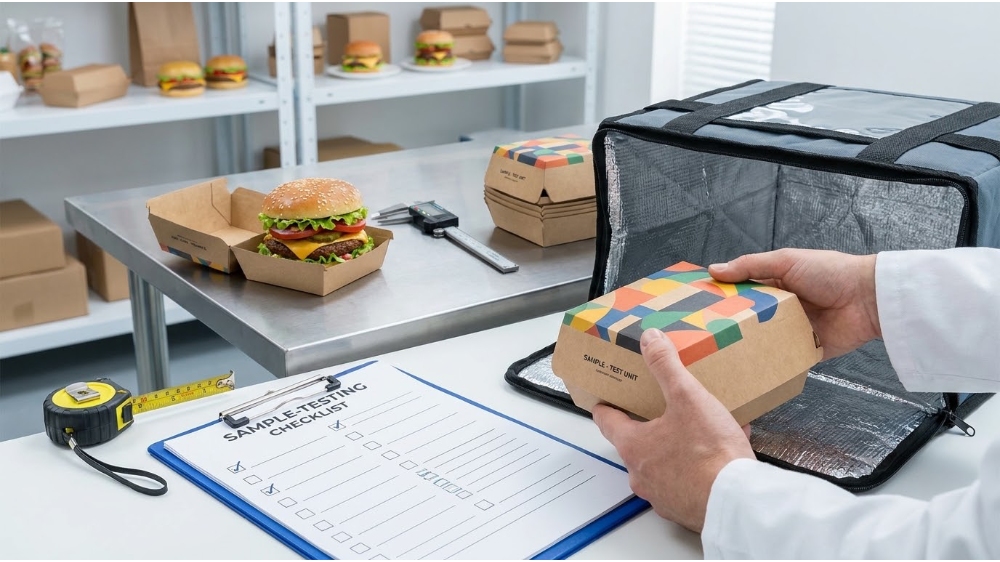
Before approving a bulk order, test a physical sample with the actual burger. A drawing or size chart helps narrow the options, but it cannot fully show how the box behaves when loaded, closed, stacked, and carried.
Use this checklist to compare candidate boxes consistently:
Measure the representative burger: Record its maximum width, depth, and height after normal assembly.
Include the tallest normal build: Check the menu variation most likely to touch the lid.
Close without force: Confirm that the lid and locking tabs engage without pressing the bun or toppings.
Check movement: Place the closed box in the intended delivery bag and assess whether the burger shifts or tilts under ordinary handling.
Inspect the base and walls: Look for bending, buckling, or loss of shape under the loaded product.
Review the arrival condition: Open the sample after a representative holding and transport period, then inspect the bun, toppings, and presentation.
Confirm the final specification: Record internal dimensions, structure, board details, closure design, and any agreed tolerances before production.
Keep the conditions consistent when comparing two samples. Use the same burger build, loading method, bag arrangement, and handling period. If a box fails, identify the cause before changing the specification. For example, lid contact may require more usable height, while sliding may call for a better footprint rather than a taller cavity.
For bulk buyers, the approved sample should represent the final production design. A change to the dimensions, folds, locking features, or board specification can affect the usable space and performance. Recheck the sample when a material or structural change could alter the fit.
Use a Clear Specification When Requesting a Quote
To reduce confusion between suppliers, share the maximum assembled burger dimensions, intended service method, preferred box style, and whether a liner or wrap will be used. Ask the supplier to state internal dimensions separately from external dimensions. If delivery is the main use, describe the bagging and stacking conditions the package must accommodate.
This gives the supplier a more useful brief than asking for a “standard burger box“. It also makes quotations easier to compare because the proposed options can be assessed against the same food dimensions and operating requirements.
The Practical Takeaway for Foodservice Buyers
Mini, regular, and stacked burgers do not need to be matched to a universal box-height chart. They need packaging sized around the finished burger, the available internal space, and the way the closed box will be handled. Use published ranges only to shortlist possible dimensions, then confirm the fit with the actual food.
For a mini burger, prioritize compact control without squeezing the bun. For a regular burger, balance lid clearance with a stable footprint. For a stacked burger, assess the height alongside sidewall support, base stability, and closure security. Before placing a bulk order, approve a loaded sample under representative conditions and record the final specification clearly.
Looking for Burger Packaging Matched to Your Menu?
Discuss your burger dimensions, box height, structure preferences, and order requirements with Maibao’s packaging team.
Not necessarily. The finished height depends on the patty thickness, bun, and toppings, so measure the assembled burger rather than using patty count as the only guide. A wider or more stable base may also be needed if the stack is prone to tipping.
Should burger box dimensions be internal or external?
Use internal dimensions to evaluate food fit and lid clearance. External dimensions are more useful for storage, shipping cartons, and delivery-bag planning. Always ask the supplier which measurement convention is being quoted.
How can buyers reduce the risk of a tall burger being crushed?
Measure the tallest normal burger build, then test a closed sample for contact between the lid and the top bun or toppings. Check the loaded box in the intended bag and confirm that stacking does not put pressure on the burger.
Is a deeper box always better for stacked burgers?
No. A deeper box may provide the needed headroom, but too much unused space can allow the burger to shift. Choose a combination of internal height, footprint, sidewall support, and closure that fits the actual build.
Post time:
Oct-22-2026
For inquiries about our products or pricelist, please leave your email to us and we will be in touch within 24 hours.