

This guide breaks down how each barrier works at the fiber level, where each one fails on a hot burger, and how to turn hold time, fat load, and disposal access into a specification you can test before ordering in volume.
Burger Box Barriers: Greaseproof vs PE vs Compostable Board
Foodservice Packaging Guide
Burger Box Material Guide: Grease-Proof, PE-Laminated & Compostable Board Applications
The right burger box barrier is a performance specification, not a sustainability label. Grease-proof keeps board recyclable but weakens on hot, fatty delivery; PE survives grease and long holds but blocks standard recycling; compostable coatings carry certification most customers cannot use and soften near serving heat.
Most burger box buyers are asked to choose between “grease-proof,” “PE-coated,” and “compostable” as if these were three grades of the same thing. They are three different barrier systems with different failure points, and the label on the carton usually tells you nothing about which one you are actually getting.
How the Three Burger Box Barriers Actually Work
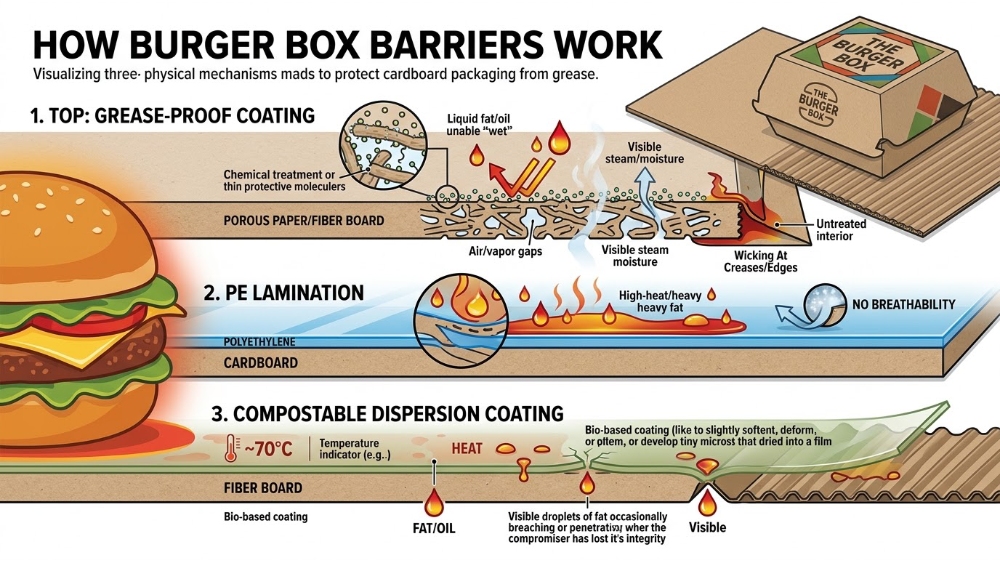
A burger box barrier is a physical system, not a material category. Grease-proof coatings, PE lamination, and compostable dispersion coatings protect the board by three different mechanisms, and each mechanism sets its own ceiling on what the box can survive.
Grease-proof coatings are applied chemistry rather than a film. Oil-and-grease-resistant (OGR) formulations lower the surface energy of the fiber so liquid fat cannot wet the sheet. The board stays porous, which helps steam escape, but there is no physical wall. Once fat passes a fold line, a cut edge, or an uncoated seam, it wicks through the fiber freely.
PE lamination bonds a continuous extruded polyethylene film to the board. It is a wall. Performance does not depend on how evenly a coating dried or how well a film formed, which is why it survives heat and heavy fat that defeat thinner barriers. The cost is that the board no longer breathes anywhere the film covers.
Compostable dispersion coatings — PLA and bio-based aqueous alternatives — are applied as a liquid and must dry into a continuous film. Their performance depends on film integrity and on thermal limits. A polymer that behaves like glass at room temperature can soften close to 70°C, which sits inside the range of a burger leaving the pass.
Substrate choice compounds all three. Corrugated board adds an air gap that changes heat retention and gives migrating grease more surface to travel along, while flat board remains the norm for clamshells. Whatever the substrate, the barrier is the only part of the box in contact with the burger.
Grease-Proof Coatings: The Performance Ceiling and the Regulatory Squeeze
PFAS-free grease-proof board is the correct specification for counter service and moderate-fat menus. It is a marginal choice for a hot, high-fat burger that spends 25 minutes in a delivery bag.
The published performance window is narrow. PFAS-free greaseproof paper is reported to resist oil penetration at 180°F for up to 10 minutes, with roughly 70% less visible grease migration than standard kraft board over the same period. Ten minutes covers a burger eaten at the counter. It does not cover a delivery order.
Failure is also uneven across the box. Wicking begins where the coating has been stretched or severed — fold lines, cut edges, and glued seams — before it appears on the flat face. A box that looks clean in the middle can already be compromised at the corners.
The regulatory pressure cuts both ways. Restrictions on PFAS have moved most foodservice board away from long-chain fluorochemistry, which genuinely reduces migration risk. But “PFAS-free” is a regulatory floor, not a performance guarantee. Many replacement formulations are proprietary, and buyers often cannot confirm which chemistry is on the sheet they are ordering.
Questions that change the grease-proof answer:
- What specific coating chemistry is on the board, and is it disclosed in writing?
- At what time and temperature was grease resistance tested — on a fatty burger or on room-temperature oil?
- Are fold lines and cut edges coated, or is the barrier only on the flat surface?
- Is the board repulpable in the mills that actually serve your region?
PE Lamination: The Benchmark and Its Recycling Cost
PE lamination remains the most reliable barrier for hot, high-fat burgers held through a delivery window, and it costs the operator the recycling claim.
The performance case is straightforward. A continuous polyethylene film holds under sustained heat, where wax coatings soften and aqueous coatings depend on a film that may not survive folding. For a burger with rendered fat, melted cheese, and sauce, that margin is the difference between a box that holds and a box that shows a grease ring before the customer opens it.
The disposal cost is equally straightforward. PE-coated board is generally not accepted in standard paper recycling streams, because the film has to be separated from the fiber and most mills will not take it. A box marketed as “paper” therefore lands in general waste in most jurisdictions.
The honest positioning is a trade, not a failure. For 20 to 30 minute delivery of a high-fat burger, PE is often the specification that performs. For five-minute counter service, it is barrier capacity the operator pays for and never uses.
Compostable Coatings: The Gap Between Certification and Infrastructure
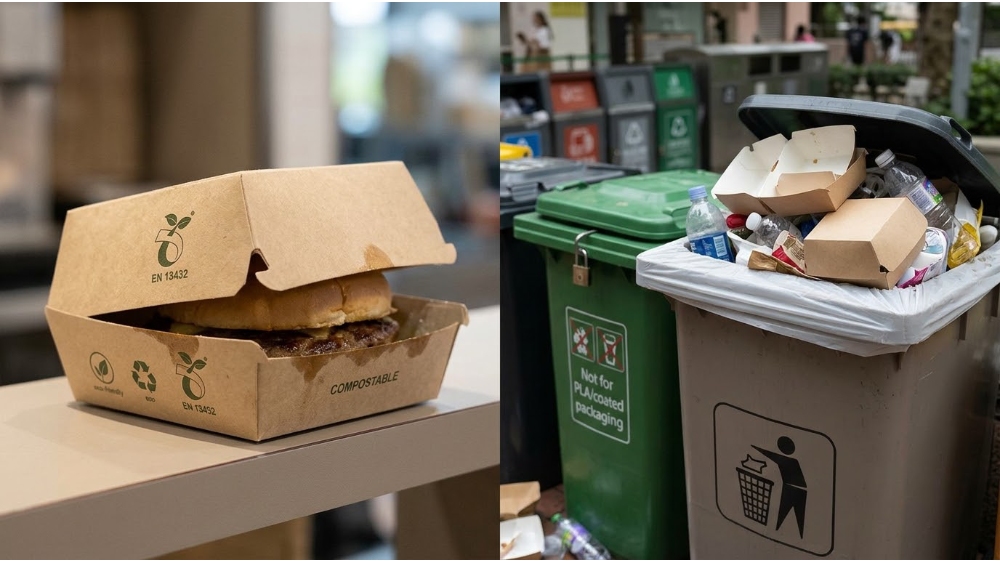
A compostable burger box is a systems decision, not a material upgrade. EN 13432 certification proves the box can biodegrade in a controlled industrial facility. It does not prove the box will be composted, and it does not make the coating heat-resistant.
What certification covers is narrow and specific: disintegration and biodegradation under defined industrial conditions, plus limits on heavy metals and ecotoxicity. It does not cover home composting, and it does not cover litter degradation. A certified box in a general waste bin behaves exactly like any other coated board.
The thermal limit matters more than the certificate in daily use. A certified PLA-lined burger box is typically rated for grease and oil resistance up to about 70°C for a maximum of 30 minutes. A burger straight off the pass, sealed in a box, sits at or near that boundary — and the rating is a ceiling, not a working margin.
Where compostable coatings genuinely win is in operations with a commercial composting partner and a menu whose fat load or hold time stays inside the coating’s rating. Without that collection path, the environmental argument rests on the material rather than on what actually happens to the box.
Choosing by Grease Load, Hold Time, and Disposal
Specify the barrier from three inputs, in this order: real hold time, fat and moisture load, and disposal reality. Material preference comes after all three.
Measure hold time first. Time from pass to customer, not the target printed on a delivery promise. If the average order reaches the customer at 22 minutes, design for 30 and treat anything shorter as margin.
Then judge the fat load. A smashed patty with cheese and a wet sauce releases more rendered fat and steam than a grilled chicken fillet. Higher fat and higher surface moisture push the specification toward PE or a heavier dispersion coating.
Then check disposal. Recyclability and compostability only carry value if your customers can reach the stream that accepts the box. A repulpable grease-proof box in a market with no paper recovery is a landfill box with a better label.
Before committing to volume, run a validation on your own product. Pack a hot burger, seal the box, and inspect at 10, 20, and 30 minutes. Check fold lines, corners, and cut edges first, because that is where barriers fail. If grease appears at 15 minutes on a box specified for 30, the specification is wrong, not the burger.
One exception is worth stating plainly. Counter service under 10 minutes rarely justifies PE. A grease-proof board is usually sufficient, and specifying a heavier barrier adds disposal cost without improving the customer’s experience.
| Barrier type | Grease and heat limit | Standard recycling | Industrial composting | Best fit |
|---|---|---|---|---|
| Grease-proof (PFAS-free OGR) | Moderate — reported ~10 min at 180°F | Yes — typically repulpable | Not certified | Counter service, moderate-fat menus |
| PE-laminated board | High — holds heavy grease and sustained heat | Generally no — film must be separated | Not certified | Delivery, 20–30 min holds, high-fat menus |
| Compostable (PLA / aqueous dispersion) | Moderate — typically ~70°C for up to 30 min | Depends on coating and local mill | Yes — EN 13432 certified | Closed-loop operations with organics collection |
The Bottom Line for Burger Box Specification
Barrier choice is a three-input specification, not a sustainability label. Grease-proof coatings keep the board recyclable and handle counter service well, but their performance window thins on hot, fatty delivery orders. PE lamination performs where grease and heat are heaviest, and takes the box out of standard recycling. Compostable coatings only deliver their end-of-life benefit where industrial composting is genuinely available, and they carry a thermal ceiling that a sealed, hot burger can approach. The most common mistake is buying on the certification mark instead of testing the candidate box on your own burger, at your own hold time, before committing to volume.
Need a burger box barrier that matches your menu and hold time?
Talk to a packaging specialist about matching coating chemistry, board grade, and disposal route to your burger’s fat load, your real delivery time, and the waste streams your customers can actually reach.
Frequently Asked Questions
Is a grease-proof burger box the same as a grease-resistant one?
No. Suppliers use both terms loosely, but they describe different claims. Grease-resistant usually means the board tolerates short contact with oil; grease-proof implies a barrier rated for a defined time and temperature. Ask for the test condition rather than the label.
Can a PE-laminated burger box be recycled?
Generally not in standard paper recycling streams, because the polyethylene film has to be separated from the fiber. Some mills and regional programs do accept poly-coated board where a specific takeback exists, so confirm with your local recovery infrastructure instead of assuming either way.
Will a compostable burger box break down in a home compost bin?
Not reliably. EN 13432 certifies performance under industrial composting conditions, where temperature and turning are controlled. A home pile rarely sustains those conditions, so a certified coated box may persist far longer than the certification suggests.
Post time: Oct-21-2026